

The natural skincare world has never had more options. Walk into any clean beauty boutique or scroll through a skincare subreddit and you'll bump into passionate advocates for sea buckthorn oil, bakuchiol serum, and — increasingly — grass-fed whipped tallow. All three are plant or animal-based. All three are marketed as nutrient-rich and skin-loving. All three have real science behind them.
So how do they actually compare? And more importantly, which one belongs in your routine?
Let's go deep.
First: These Aren't All the Same Type of Product
Before we compare them side by side, it's worth naming something that often gets glossed over in skincare content: these three products are not doing the same job.
Grass-fed tallow is a full-spectrum moisturizer and skin nourisher. It hydrates, seals, feeds the skin barrier, and works as a complete daily moisturizer for face and body.
Sea buckthorn oil is a potent, nutrient-dense treatment oil. It's packed with antioxidants and fatty acids, but it's typically used as a targeted treatment ingredient — not a standalone daily moisturizer.
Bakuchiol is a treatment active. It's the natural retinol alternative — designed to stimulate collagen, improve tone, and address signs of aging. It is not a moisturizer.
Understanding this distinction matters, because the real question isn't just "which is better?" — it's "better for what?" With that framing in mind, let's look at each one honestly.
Sea Buckthorn Oil: The Nutrient Powerhouse
Sea buckthorn is genuinely impressive. Derived from the bright orange berries of the Hippophae rhamnoides plant, it has a nutrient profile that stands out even in a crowded field of botanical oils.
What makes it special: Research published in Lipids in Health and Disease (PMC) describes sea buckthorn as one of the only plant-based sources to contain all four omega fatty acids — omegas 3, 6, 7, and 9 simultaneously. That omega-7 content (palmitoleic acid in particular) is what sets it apart — it's a fatty acid naturally found in human skin, with documented benefits for wound healing and barrier repair. A review published in Frontiers in Pharmacology confirmed that sea buckthorn seed oil has genuine regenerative properties on normal skin cells, supporting both keratinocytes and fibroblasts — the two key cell types responsible for your skin's structure.
Research in PMC also shows that sea buckthorn's unique unsaturated fatty acids, including palmitoleic acid (omega-7) and gamma-linolenic acid (omega-6), give it skin regeneration and repair properties — and that it penetrates the epidermis easily, which helps those nutrients actually reach the cells that need them.
Where it shines: Anti-aging, barrier repair, dry and irritated skin, UV-damaged skin. A study in PMC found that sea buckthorn seed oil partially protects skin cells against UV-induced damage and helps restore the lipid levels that UV radiation depletes. For people dealing with eczema, psoriasis, or rosacea, it has genuine anti-inflammatory credentials.
The catch: Sea buckthorn oil has one well-known quirk — it's intensely orange. Applied directly to the skin in undiluted form, it will temporarily stain your face. This is why it's almost always used as a diluted component within a formula rather than applied neat. It also has a distinctive, strong smell that not everyone loves. And as a plant oil, its fatty acid profile — while rich — doesn't mirror human sebum the way tallow does.
Bakuchiol: The Natural Retinol Alternative
Bakuchiol is having a serious moment, and for good reason. Derived from the seeds and leaves of the Psoralea corylifolia (babchi) plant, it's been studied as a gentler, plant-based stand-in for retinol — and the research holds up surprisingly well.
What the science says: A landmark randomized double-blind study published in the British Journal of Dermatology found that bakuchiol and retinol both significantly decreased wrinkle surface area and hyperpigmentation, with no statistical difference between the compounds — but retinol users reported more facial skin scaling and stinging. That's a meaningful finding. Bakuchiol offers comparable anti-aging results with a gentler tolerance profile.
Harvard Health also notes that a small study found bakuchiol to be just as effective at erasing fine lines and improving skin color as retinol, but with less peeling and burning.
A comprehensive review in the Journal of Integrative Dermatology concluded that bakuchiol may be considered as a key ingredient for individuals with sensitive skin who may not tolerate topical retinoids, and those who are pregnant, nursing, or trying to conceive.
Where it shines: Fine lines, uneven tone, collagen support, photoaging. If you're looking for something to actively treat signs of aging — not just nourish — bakuchiol is a legitimate option.
The catch: Bakuchiol is a treatment, not a moisturizer. It doesn't deeply hydrate. It doesn't repair a compromised skin barrier. It doesn't provide the kind of nutritive, biocompatible fatty acids your skin needs to stay plump, protected, and resilient day to day. As Cleveland Clinic notes, while bakuchiol measures up well against retinol, further research is needed to see how it compares to prescription retinoids that tackle more serious skin issues. Its evidence base, while promising, is still relatively small compared to retinol's decades of research.
It's also worth noting that while bakuchiol is plant-derived and generally gentle, it's still a single active ingredient in a carrier formula — usually combined with silicones, emulsifiers, and preservatives in commercial products.
Grass-Fed Whipped Tallow: The Biocompatible Base
Now let's talk tallow. Rendered from the fat of pasture-raised, grass-fed cattle, whipped tallow is one of the most ancient skincare ingredients in human history — and it holds up remarkably well under modern scientific scrutiny.
What makes it unique: The core argument for tallow isn't just that it's natural — it's that it's biologically compatible with human skin in a way that plant oils aren't. Your skin produces its own fat (sebum), and tallow's fatty acid profile — rich in oleic acid, palmitic acid, stearic acid, and conjugated linoleic acid (CLA) — closely mirrors what your skin makes naturally. When you apply tallow, your skin essentially recognizes it as familiar and draws it in rather than just sitting on the surface.
A 2024 peer-reviewed scoping review confirmed that grass-fed tallow is rich in fat-soluble vitamins A, D, E, K, and B12 — all directly relevant to skin health. Vitamin A supports cell turnover. Vitamin D strengthens the barrier. Vitamin E provides antioxidant protection. Vitamin K supports skin resilience and tone. These don't come from a lab — they come from the living biology of a pasture-raised animal.
The "grass-fed" distinction matters here specifically. Grass-fed tallow is significantly higher in CLA (conjugated linoleic acid) than grain-fed alternatives. CLA is a powerful anti-inflammatory fatty acid that supports skin elasticity, reduces redness, and helps maintain barrier function. You simply don't get this in the same concentration from a grain-fed source.
Where it shines: Deep daily moisturizing, barrier repair, sensitive and reactive skin, eczema and psoriasis, dry and mature skin, and anyone who wants to simplify their routine to one truly multi-purpose product. Because it doesn't require water, synthetic emulsifiers, or preservatives, a well-made whipped tallow is one of the cleanest formulas you can put on your skin.
The honest trade-offs: Tallow is animal-derived, so it's not suitable for vegans. It's also not a targeted treatment active — it won't stimulate collagen the way bakuchiol does, and it doesn't have the same antioxidant density as sea buckthorn's flavonoid-rich berry oil. It's a nourisher and protector first.
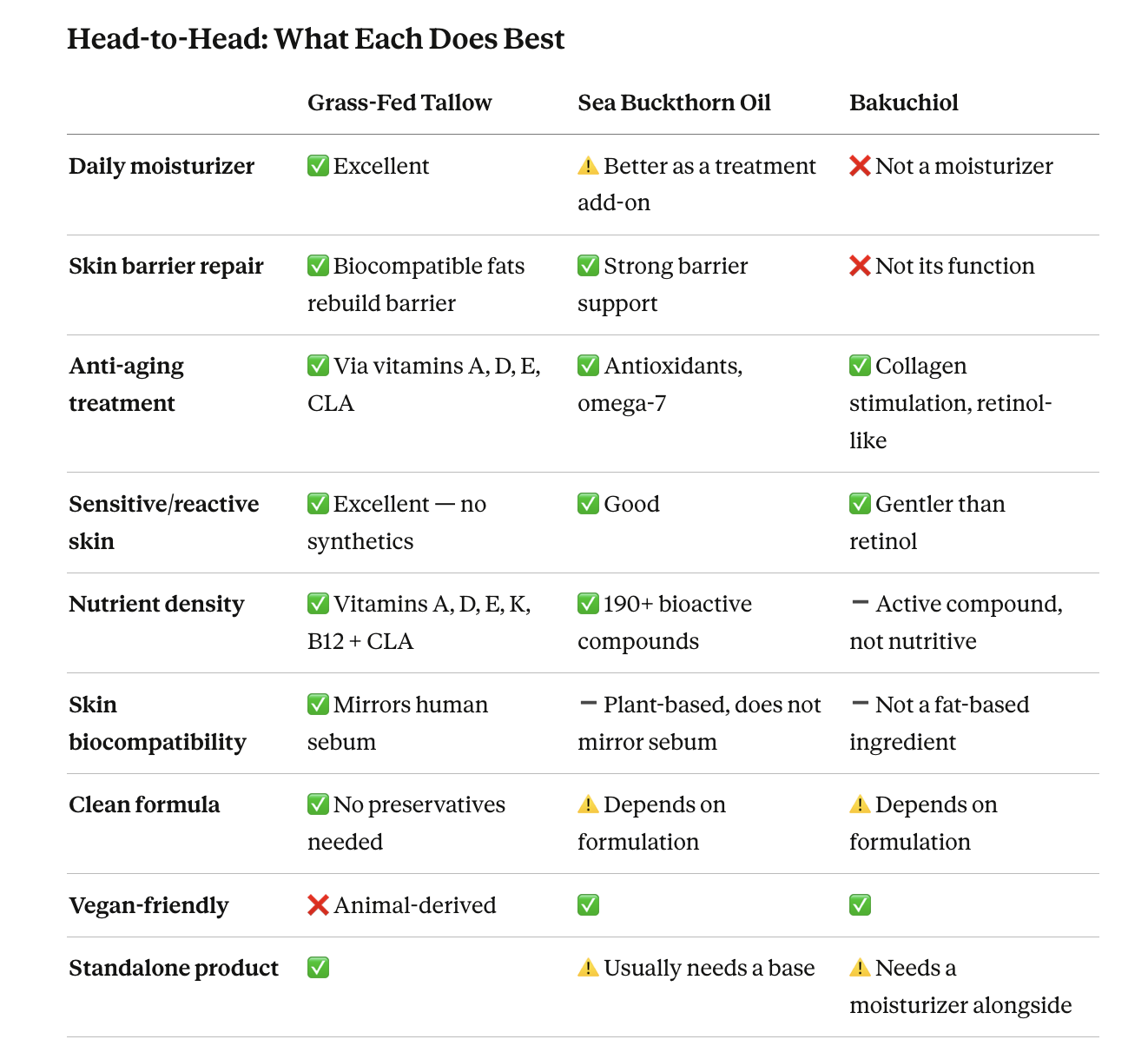
Head-to-Head: What Each Does Best
So Which One Should You Use?
Here's the honest answer: it depends on what your skin needs — and these three products don't have to be competitors.
If your skin is dry, sensitive, reactive, or barrier-compromised, whipped tallow is your foundation. It does the most complete job of nourishing, protecting, and repairing skin day to day, with nothing synthetic required. Start here and see how your skin responds.
If you want to add antioxidant protection or target aging, UV damage, or inflammation, sea buckthorn oil is a worthy addition — particularly if you find a formula where it's well-incorporated and the orange pigment is managed.
If you're focused on anti-aging and want to actively stimulate collagen and address fine lines, bakuchiol is a compelling treatment layer to add on top of your moisturizing routine. It pairs beautifully with tallow — apply your tallow first to nourish and seal, and layer bakuchiol over time as a targeted treatment.
The real insight here is that whipped grass-fed tallow is the one product on this list that functions as a complete daily moisturizer. Sea buckthorn and bakuchiol, for all their real merits, are best understood as supporting players — impressive in their specialties, but not designed to do what tallow does at its core.
The Bottom Line
Natural skincare is finally getting the nuanced conversation it deserves. Sea buckthorn is genuinely remarkable. Bakuchiol is the real deal for collagen support. And grass-fed tallow is the biocompatible, nutrient-dense daily moisturizer that no plant-based oil can quite replicate — not because plants are inferior, but because your skin literally recognizes animal-derived fats as its own.
For most people building a clean, simplified skincare routine, whipped tallow is the best place to start. Everything else can be built around it.
Note: The statements in this post have not been evaluated by the FDA. Our products are not intended to diagnose, treat, cure, or prevent any disease. Individual results may vary. Consult a healthcare professional for specific skin conditions or concerns.
